Showing all 7 results
The Sopras Tek undersuit range spans seven garments from a 100 g standard base layer through Thinsulate-lined Metalux 200 and 300 suits for cold and near-freezing water temperatures. All are designed to be worn inside a dry suit, where they provide the primary thermal protection — the dry suit itself maintains the watertight barrier. Choosing the right undersuit fill weight for the water temperature and dive duration is the single most important thermal management decision in dry suit diving.
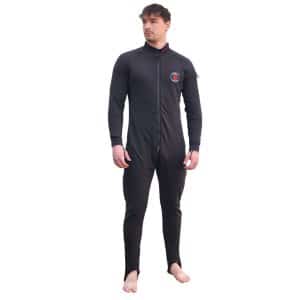
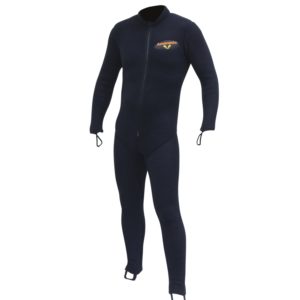
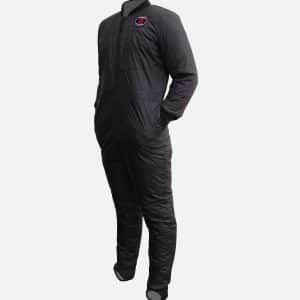
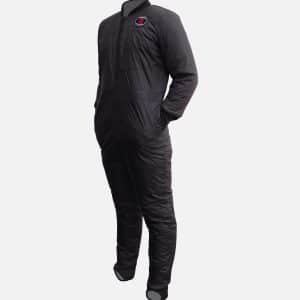
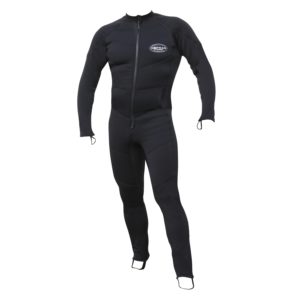
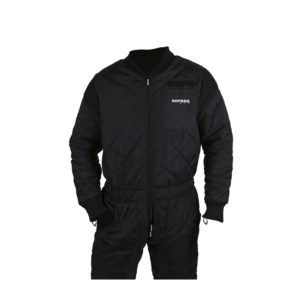
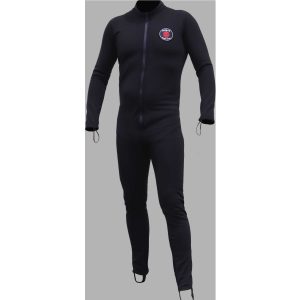
Dry Suit Undersuits
In a dry suit system, the undersuit provides the insulation — the suit provides the waterproof barrier and the trapped air layer. Selecting an undersuit matched to water temperature, dive depth, and dive duration is as important as selecting the suit itself. Undersuits compress slightly at depth, reducing insulation, which must be accounted for when planning thermal protection for deeper dives.
Fill Weights and Temperature Matching
The Undersuit standard 100 g (126 €) and Fleece undergarment (99 €) are appropriate for temperate water in the 15–18 °C range, or as a base layer under a heavier undersuit in cold conditions. They provide minimal compression at depth and work well inside neoprene dry suits where the suit itself provides the primary insulation.
The Bodycore 200 (153 €) and Thermax (198 €) sit in the mid-range, suited to 10–15 °C water temperatures for typical 45–60 minute dives. They provide meaningful insulation without excessive bulk, allowing good freedom of movement inside a trilaminate suit.
The Undersuit Activa 350 g (207 €) is a thick, Thinsulate-lined garment for 5–10 °C or colder water. The high fill weight is appropriate for longer dives, decompression diving where surface intervals may be extended, and any environment where extended time in cold water is expected.
The Metalux 200 (239 €) and Metalux 300 (261 €) use a metallised inner lining in addition to the thermal fill — the metallised layer reflects radiant body heat back to the diver rather than allowing it to dissipate into the air layer. This construction provides better insulation per gram of fill weight than standard synthetic undersuits. Metalux suits are suited to 8–14 °C (200) and 5–10 °C or colder (300).
What to Look For
- Water temperature as the primary guide: Start with the water temperature at the bottom of the dive profile, not the surface. Thermoclines can produce significant temperature drops between the surface and the dive depth. A 300 g undersuit that is comfortable at 10 m may be necessary to be warm at 40 m in the same body of water.
- Compression at depth: All undersuits compress with depth and lose some insulation. Higher fill weight provides a larger margin — a 350 g suit compressed to 250 g equivalent still provides more protection than a 100 g suit. For dives below 30 m with extended decompression, specify a higher fill weight than the surface temperature alone suggests.
- Fit inside the suit: The undersuit must fit inside your specific dry suit without bunching at the knees or restricting arm reach. Too much bulk will reduce range of motion, particularly in valve operation and reaching back-mounted cylinders. Try the combination before committing to deep or overhead dives.
- Metalux advantage: The reflective metallised lining in Metalux garments provides genuine performance benefits in extended cold dives. The price premium over equivalent fill weight suits is justified for regular diving in water below 12 °C.
Maintenance and Care
Undersuits should be rinsed with fresh water after each dive and allowed to dry completely before storage. Avoid compressing or folding synthetic fill garments for extended periods — store flat or loosely folded to maintain loft. Wash according to the manufacturer’s instructions; most synthetic undersuits tolerate machine washing on a gentle cycle with mild detergent. Do not tumble dry at high heat, which can damage synthetic fibres and reduce loft. Fleece garments are more durable in washing but should also be dried away from direct heat sources.
FAQ
Can I layer two undersuits for extra warmth?
Layering is possible if the dry suit has sufficient internal volume — neoprene suits typically do not, but trilaminate suits often have enough room for a thin base layer under a main undersuit. A common cold-water configuration is a 100 g or fleece base layer under a Metalux 200 or Activa 350. Test the combination for range of motion before diving.
What does Metalux metallised lining do?
The metallised inner surface of Metalux undersuits reflects radiant heat from the body back inward rather than letting it dissipate into the air layer inside the suit. This is the same principle as a space blanket, but integrated into a wearable garment. The practical result is better insulation for a given fill weight, which is why Metalux suits are priced higher than equivalent non-metallised alternatives.
Should I wear an undersuit with a neoprene dry suit?
A light undersuit is still recommended — a 100 g standard or fleece undergarment provides moisture wicking and a small insulation boost. Heavy undersuits are generally not suitable for neoprene dry suits due to the limited internal volume of neoprene construction; they restrict movement and can interfere with the fit of the suit itself.