The Tanks and Accessories range at Sopras Tek covers aluminium cylinders and the complete hardware required to configure, connect, and rig them for technical diving — isolation manifolds for backmount doubles, single and modular valves for all gas types, twin tank bands and complete twin sets, stage and sidemount bottle rigging hardware, argon system components, and single-tank mounting accessories. For a broader selection of steel cylinders and sizes, see the full range at Sopras Tanks.
For more Tanks please check Sopras Tanks
Diving Cylinders and Configuration Hardware
Aluminium tanks
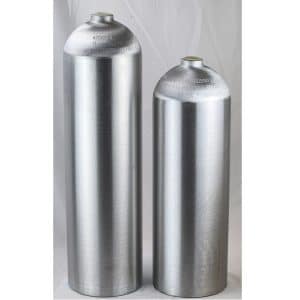
CE-certified 6061-T6 aluminium cylinders in S80 (11.1 L) and S63 (9.0 L) configurations. Standard 200 bar working pressure, G 5/8″ DIN connection. 227–243 €.
Accessories for tanks
Valves (isolation manifolds, modular SM valves, Nitrox/Argon, rebreather), twin tank gear (bands, complete sets, boots), bottle rigging hardware for stage and sidemount, and argon system holders and sets.
Cylinder Materials and Selection
Technical divers typically work with two cylinder materials: aluminium alloy (6061-T6) and steel. Each has distinct buoyancy, capacity, and maintenance characteristics that determine its appropriate application in the dive configuration.
Aluminium cylinders are corrosion-resistant, widely available, and rated to 200 bar. Their key buoyancy characteristic is that they shift from negative (full) to positive (empty) over the course of a dive — a behaviour that must be accounted for in the buoyancy plan. This makes them less suitable as back gas for deep technical dives but ideal as stage, decompression, and bailout bottles where the lighter aluminium weight reduces sling fatigue and the positive-swing buoyancy is managed as a known variable. The S80 (11.1 L, 80 cuft) is the global standard for dive centre fills and stage bottle configurations; the S63 (9.0 L, 63 cuft) is commonly used as a lighter deco or bailout bottle.
Steel cylinders (available through Sopras Tanks at soprassub.com) offer higher capacity, higher working pressures up to 300 bar, and consistent negative buoyancy throughout the dive — the shift from full to empty is a change in degree of negativity rather than a polarity flip. For backmount doubles as primary back gas in technical diving, steel is the standard choice.
Valves and Manifolds
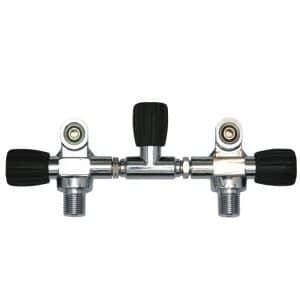
The valve is the critical interface between cylinder and regulator. Sopras Tek carries the full range of valve types required for technical diving configurations: isolation manifolds for backmount doubles (232 bar and 300 bar, ISOL and screw formats), modular left/right valves for building or replacing manifold assemblies, Nitrox and Argon-specific valves (oxygen-cleaned, with appropriate connection standards), and dedicated rebreather valves for CCR cylinder configurations.
The isolation manifold — available in both 232 bar and 300 bar versions across multiple cylinder diameter formats — is the defining hardware component of a backmount double set. It connects both cylinders at the top while incorporating a central isolation valve that can shut off gas flow between the left and right sides. In the event of a valve, regulator, or first stage failure on one side, the isolation valve preserves the gas in the unaffected cylinder — a fundamental redundancy principle in technical diving that cannot be replicated without an isolation manifold.
Twin Tank Gear and Configuration
Building a backmount double set from individual cylinders requires: two cylinders, a manifold, two stainless steel tank bands, and a set of twin tank bolts to assemble the bands at the correct spacing. Complete Twin tanks sets (635–846 €) are available for divers who want a ready-to-dive configured double set including cylinders, manifold, and bands in matched specification. Individual bands, boots, and EPDM tank protectors are available for assembling or servicing existing sets.
Bottle Rigging for Stage and Sidemount
Stage and decompression bottles require secure two-point rigging — a bolt snap at the neck and a bungee retainer at the base — to keep the bottle streamlined against the diver’s side and prevent rotation or swing during the dive. The rigging hardware must match the specific cylinder diameter: the Sopras Tek range covers 130–160 mm cylinder diameters as well as cylinder-specific sets for 7 L/S40, 10 L/12 L long steel, and S80 aluminium configurations. Sidemount-specific rigging (SM bottle rigging) and neoprene hose holders for SM hose management are also available.
Argon Systems
Technical divers using dry suits typically carry a dedicated argon cylinder for suit inflation rather than routing LP gas from the back gas. Argon provides better insulation than air and avoids contaminating the back gas supply. The argon system at Sopras Tek includes 1 L and 3 L cylinder holders in multiple mounting configurations, complete argon tank sets (cylinder, valve, regulator — 176–180 €), and the Argon valve with M18×1.5 and G 5/8″ connection standards.
What to Look For
- Manifold pressure rating and format: Confirm your cylinders’ working pressure (232 bar or 300 bar) and valve thread format (ISOL with isolation valve, or screw SA/LI without) before ordering a manifold. The manifold length must also match your cylinder diameter (171 mm or 203 mm) — an incorrectly sized manifold will not seat correctly and cannot be sealed.
- Left vs. right valves: In a backmount double set, the left cylinder takes a left-hand (left) valve and the right cylinder takes a right-hand (right) valve. This determines which direction the valve knob turns to open and close — critical for the standardised valve drill used in technical diving. The Sopras Tek valves category includes a reference diagram of left vs. right valve identification.
- 232 bar vs. 300 bar: O-rings, manifold parts, and valve internals are pressure-rated. Do not mix 232 bar components with cylinders rated to 300 bar. The product names and SKUs on the Sopras Tek site explicitly state the pressure rating — verify before ordering replacement parts or mixing components from different sets.
- Cylinder inspection status: Any cylinder being configured for diving must be within its inspection validity (annual visual + 5-year hydro). Cylinders filled with enriched air or oxygen must be oxygen-cleaned. Confirm the status before configuring a valve or manifold on a cylinder that has been in storage.
- Stage rigging size: Identify your specific cylinder diameter before ordering stage rigging. The 130–160 mm rigging set covers most standard aluminium stage bottles; specific sets exist for 7 L/S40, 10 L/12 L long steel, and S80 cylinders. Using the wrong rigging size produces a loose fit that shifts under load.
Maintenance and Care
Rinse all metal hardware — valve bodies, manifold parts, tank bands, bolt snaps — with fresh water after every saltwater dive. Salt crystallisation in valve threads and manifold connections causes corrosion that can eventually seize components or degrade o-ring sealing surfaces. Never fully empty cylinders — maintain at least 10–20 bar residual pressure to prevent moisture ingress. Inspect manifold o-rings before every dive for nicks, extrusion, or debris. Stainless steel tank bands should be checked for tightness and corrosion at band-to-bolt interfaces at least every dive trip. Bungee cord on stage rigging fatigues and loses elasticity — test before each expedition and replace when the bottle is not held firmly against the body. Store cylinders vertically or horizontal with the valve cap in place to protect valve threads.
FAQ
Should I use aluminium or steel cylinders for technical diving?
Steel for backmount doubles as back gas — higher capacity, consistent negative buoyancy throughout the dive, and less lead needed. Aluminium for stage and decompression bottles — lighter, corrosion-resistant, globally available in standard sizes. Many technical divers use both in the same configuration.
What is an isolation manifold and do I need one?
An isolation manifold connects both cylinders in a backmount double set and includes a central valve that can shut off gas flow between the left and right sides. If a valve or regulator fails on one side, closing the isolation valve preserves the gas in the unaffected cylinder. It is standard equipment for technical diving doubles — without it, a single failure can result in losing the entire gas supply from both cylinders simultaneously.
What is the difference between ISOL and screw SA/LI manifold formats?
ISOL manifolds use an integrated isolation valve in the centre bridge — the standard technical diving configuration that enables shutting off one side independently. Screw SA (screw, same-axis) and screw LI (screw, left-integrated) are formats that describe how the valve body attaches to the manifold bridge. The key selection criterion is matching the manifold to your specific cylinder diameter and valve thread. Consult the product descriptions or contact Sopras Tek service if unsure.
How do I rig a stage bottle correctly?
Standard stage rigging uses two attachment points: a bolt snap on the first stage regulator or neck ring, clipped to a D-ring on the diver’s chest or shoulder; and a bungee loop around the bottom of the cylinder, clipped to a hip D-ring. The bottle should lie parallel to the body with the valve facing forward and the SPG readable without removing the bottle. The neck regulator should be stowed so the second stage is clipped off and not dangling. Select rigging hardware matched to your cylinder diameter — see the Bottle Riggings subcategory for size-specific sets.