Showing all 9 results
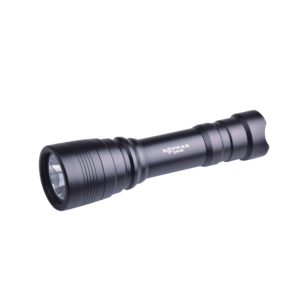
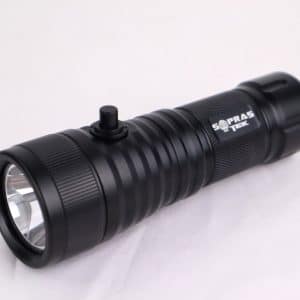
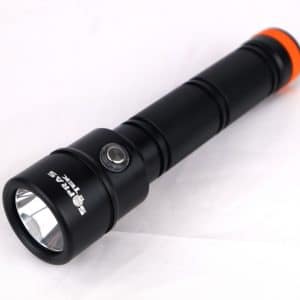
The SY light range covers the full spectrum of technical diving illumination — from compact backup torches and a head-mounted lamp through handheld primaries at 1250–3000 lumens, a wide-angle video torch, a canister light with remote head, and the SY 4500 high-output primary. All models are designed for overhead environment use where light redundancy is an operational requirement, not a recommendation.
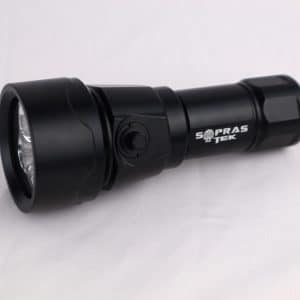
Primary and Backup Light Systems for Technical Diving
Technical diving — particularly in overhead environments such as wrecks and caves — requires a minimum of three independent light sources: one primary light and two backup lights. The logic is straightforward: a single light failure inside an overhead environment with no ambient light is a life-threatening situation. Redundancy in lighting follows the same principle as redundant gas supply. A primary light failing does not end the dive — the diver switches immediately to a backup and begins a controlled exit.
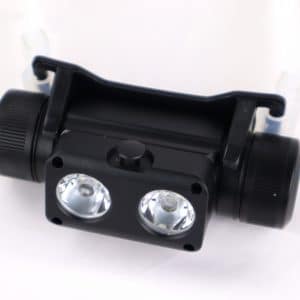
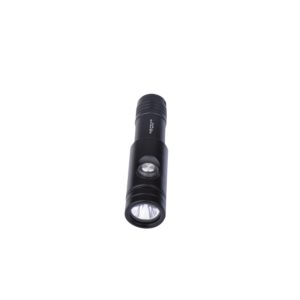
The SY range addresses all three positions. The SY 100 and SY 105 are compact handheld units appropriate for backup roles, carried bolt-snapped to chest D-rings where they are immediately accessible. The SY 05 head lamp (1300 lm) provides hands-free illumination mounted to the mask strap or helmet — useful for equipment checks, reading gauges, and deco stop management. Handheld primaries — the SY 25 and SY 51 at 3000 lm — bridge the gap between compact backup and high-output primary. The SY 27 (1250 lm with integrated laser pointer) provides a communication and reference tool alongside its illumination function. At the top of the range, the SY 10 canister torch (3000 lm) and the SY 4500 Primary Torch represent the high-output, extended-burn primary light specification for penetration and exploration diving.
Canister vs. Handheld Primary Lights
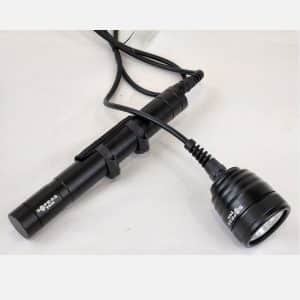
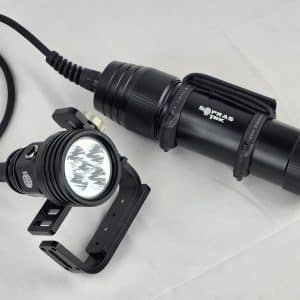
The traditional primary light for technical and cave diving is a canister light — a light head connected by a cable to a separate battery canister clipped to the harness or D-ring. The canister houses a large-capacity battery that provides multi-hour burn times at full output. The SY 10 canister torch delivers 3000 lumens from a separate canister body connected to a remote light head, with burn time and output consistent with penetration diving requirements.
Advances in lithium-ion cell energy density — particularly the high-capacity 21700 format — have brought handheld primary lights into genuine competition with canister systems. The SY 4500 Primary Torch delivers 4500 lumens from a self-contained handheld body, representing the current high-water mark of self-contained dive light output. Many technical divers now configure three high-output handhelds rather than a canister plus two backups, gaining simplicity and symmetrical redundancy. The canister format retains its advantage for extended exploration where burn time is the primary constraint.
Beam Characteristics and Output Levels
Lumen ratings measure total light output from the source, but the usable performance of a dive light underwater depends heavily on beam angle. A narrow, focused beam — 6–12 degrees — cuts through suspended particulate, reaches further, and provides a precise reference point for navigation and team communication. Wider beams flood a larger area but lose effective range and are more degraded by backscatter in silty or particulate-heavy water.
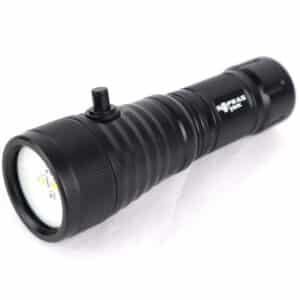
The SY 08 video hand torch (1500 lm) is an exception — it is explicitly a wide-angle video light, designed to provide even illumination across a broader field for underwater photography and video rather than for navigation or penetration. Its 1500 lm output serves a different function from the same output in a focused beam: wider coverage at shorter range rather than reach and penetration.
The SY 27 with integrated laser pointer adds a communication dimension to a 1250 lm torch. In cave and wreck diving, pointing a laser at a specific feature — a passage junction, an equipment problem, a guideline — conveys information precisely without hand signals that require both parties to be looking at the same area simultaneously. The laser pointer is a precision communication tool used in tandem with the torch beam rather than as an illumination source.
What to Look For
- Three-light configuration: Select lights to fill primary and two backup roles. The SY 100 and SY 105 are appropriate backup candidates — compact, clip-ready, reliable. The SY 25, SY 51, or SY 4500 fill the primary role depending on required output and burn time. A head lamp (SY 05) provides a useful complement for hands-free tasks without replacing a clipped backup.
- Output and burn time match to dive profile: Primary light burn time should comfortably exceed 1.5× the planned dive duration. Backup lights need enough capacity to complete a safe exit from the overhead environment or finish decompression obligations. Verify the specific output-to-burn-time curve for each model, not just peak lumen rating — most lights run multiple modes with different output/runtime trade-offs.
- Canister or handheld primary: For exploration and long penetration dives where maximum burn time is the constraint, the SY 10 canister light is the appropriate specification. For typical technical wreck and recreational cave diving, handheld primaries at 3000–4500 lm provide sufficient output and simpler configuration. Three matched handhelds offers the cleanest redundancy.
- Beam angle for environment: Penetration and navigation — focused beam. Video and wide-area illumination — SY 08 wide-angle. The SY 27 laser pointer is specifically useful in cave environments where visual communication between divers replaces hand signals for non-emergency information exchange.
- Clip and carry position: Backup lights must be immediately accessible without searching. They should be bolt-snapped to chest D-rings with the switch orientated for one-handed activation in gloves. Verify the clip point and switch position on any backup light before diving with it.
Maintenance and Care
Rinse all dive lights in fresh water after every dive, paying particular attention to the switch mechanism and the threaded joint between head and body where salt crystals accumulate and can compromise O-ring sealing surfaces. Inspect O-rings before every dive — remove, clean the seating groove, check for nicks or cracks, and apply a light smear of silicone grease before reseating. A single particle of grit on an O-ring seating surface is sufficient to allow water ingress at depth. Store lights with the head backed off slightly from full compression to relieve permanent O-ring deformation during storage. Rechargeable lithium-ion batteries should be stored at 50–70% charge in a cool, dry location — neither fully charged nor fully depleted for extended periods. Before any dive trip, test each light across all output modes, verify the switch lockout function, and check that the beam is steady without flicker, which indicates a loose connection or failing driver.
FAQ
How many lights does a technical diver need?
The minimum standard for overhead environment diving — caves and wrecks — is three independent light sources: one primary and two backups. This is a firm rule in cave diving and a strong convention in wreck penetration. The reasoning is that a single light failure underground must not create a navigational emergency; with three lights, two failures can occur and the diver still has illumination to exit safely. For open-water technical diving with decompression obligations, a primary and one backup is the common minimum, though three sources remain the safer configuration.
What is the difference between the SY 25 and SY 51?
Both the SY 25 and SY 51 deliver 3000 lumens and occupy the same handheld primary price tier (135–137 €). The difference lies in body geometry, battery configuration, and beam characteristics — the SY 51 uses a different form factor to the SY 25. Both are appropriate as handheld primary lights for technical diving. Choosing between them comes down to ergonomics, carry position, and personal fit with your existing clip and carry configuration. Check the product detail page for each model to compare dimensions and switch design.
Is the SY 4500 suitable as a cave diving primary?
Yes. The SY 4500 Primary Torch at 4500 lumens is the highest-output self-contained unit in the range and is positioned as a primary light for demanding technical environments including cave and wreck diving. Its output exceeds many canister lights. The relevant questions for cave use are burn time at your operating output level — confirm that runtime on the mode you will use covers your planned penetration with appropriate margin — and whether the carry and clip configuration integrates cleanly with your diving system.
What does the laser pointer on the SY 27 do?
The SY 27 integrates a laser pointer alongside the 1250 lm torch beam. In cave and wreck diving, a laser provides a precise communication reference — pointing at a specific feature, a guideline junction, a piece of equipment, or a passage — that is unambiguous in a way that directing a torch beam is not. The laser dot appears at the exact point of interest regardless of ambient light or beam scatter. It is used for non-emergency information exchange between divers and for pointing out features during the dive. It does not replace hand signals or light signals for standard communications.
Can I use the SY 08 video torch as a primary light?
The SY 08 is designed as a wide-angle video light rather than a navigation or penetration torch. Its 1500 lm output is functional, but the wide beam angle means it spreads light across a broad area at close range rather than projecting a focused beam useful for navigation, communication, or penetration. For video and photography purposes it is the appropriate tool. For a primary dive light role in a technical overhead environment, the SY 25, SY 51, or SY 4500 with their focused beams are better specified. The SY 08 is well suited as a secondary light for divers who combine technical diving with underwater imaging.