Showing all 8 results
Cam bands and tank belts secure cylinders to a backplate in backmount configurations — typically in combination with a single tank adapter that provides the cam band mounting slot. The quality of the cam band closure directly affects cylinder stability during the dive: a band that slips allows the cylinder to rotate or shift position, disrupting trim and potentially dislodging the regulator. Available in multiple lengths to accommodate different cylinder diameters from compact 7 l bottles to large steel 15 l cylinders.
Check here for more cylinders’ belts Belt for tanks Archives – Soprassub
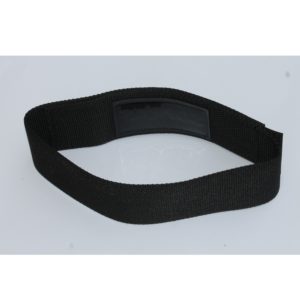
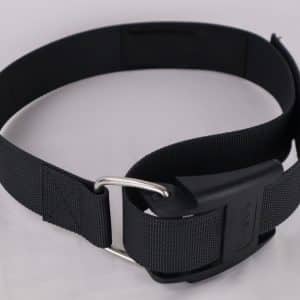
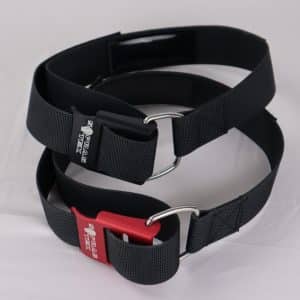
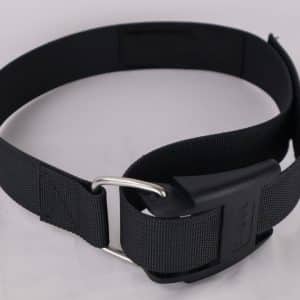
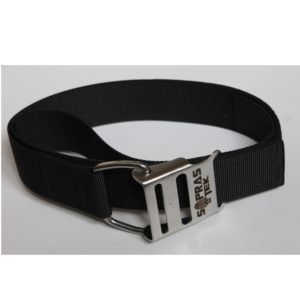
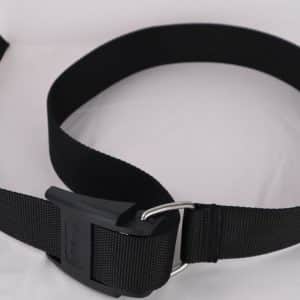
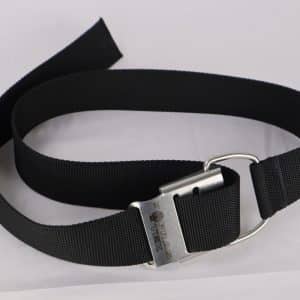
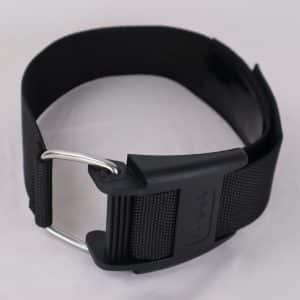
Cam Bands and Single Tank Adapters
In a backmount BP/W system, cylinders are secured to the backplate using one of two methods: a twin cylinder manifold that bolts directly to the plate via a backplate band, or a single tank adapter (STA) combined with cam bands for single cylinder use. The cam band wraps around the cylinder body, threads through a slot in the STA or directly through slots in some backplate designs, and locks in place via a spring-loaded buckle. Under load, the tension in the band is what prevents cylinder rotation — a correctly tensioned cam band should not be releasable by hand without operating the buckle.
Cam band length determines which cylinder diameters can be secured. A band that is too short cannot wrap fully around a wide-diameter cylinder; one that is too long creates excess strap that must be managed and can catch on equipment or the environment. The standard approach is to use a cam band sized for the cylinder diameter plus approximately 50 mm of adjustment range on each side of the buckle.
What to Look For
- Band length relative to cylinder diameter — measure your cylinder diameter and select a band length that allows the buckle to sit at approximately the 10 o’clock or 2 o’clock position around the cylinder (not at the top or sides). This position gives the buckle the best mechanical advantage for tensioning and makes it accessible for adjustment without removing the cylinder.
- Buckle locking mechanism — cam band buckles use a spring-loaded tooth that bites into the band under tension. The tooth must hold without slipping under the loads generated by a cylinder moving during water entry. Test the buckle by tensioning the band and applying lateral pressure to the cylinder — any movement indicates a worn or undersized tooth.
- Webbing material — nylon vs. Kevlar — standard nylon webbing is adequate for most applications. Kevlar-reinforced bands are heavier but more resistant to abrasion from cylinder surfaces and cave environments. For divers who frequently re-rig cylinders, Kevlar bands wear better at the buckle attachment point where the band bends repeatedly.
- Band width compatibility with STA slot dimensions — the cam band must thread through the STA or backplate mounting slot. Standard STA slots accept 50 mm webbing. Verify that the band width matches the slot dimensions of your backplate or STA design.
- Stainless steel buckle hardware — the buckle pivot and spring should be stainless steel for saltwater resistance. Inspect the spring tension: a weak spring does not maintain enough tooth engagement to hold the band under load. Replace springs on a worn buckle rather than replacing the entire band if the webbing is still in good condition.
Maintenance and Care
Rinse cam bands after every saltwater dive. Salt that accumulates in the buckle mechanism reduces the spring force on the locking tooth and accelerates corrosion at the pivot point. Operate the buckle several times under fresh water to flush the mechanism. Allow to dry completely before storage — a damp cam band stored in a dive bag develops mildew in the webbing weave and accelerates metal corrosion.
Inspect the webbing at the buckle attachment point annually. This is the highest-stress location — the webbing bends repeatedly at the buckle tongue, and this flexing fatigue shows as fraying or stiffening of the fibres at the bend radius. Replace any band where the webbing shows visible fraying at the buckle entry point; the band may hold under normal loads but can fail under the shock load of a cylinder shifting suddenly.
Check the cam buckle spring force by pulling the tooth back manually — it should return to the locked position crisply with clear spring resistance. A spring that allows the tooth to ease back slowly, or one that requires manual assistance to return to position, has lost sufficient tension for reliable load-holding and should be replaced.
FAQ
How tight should a cam band be on a cylinder?
The cam band should be tensioned to the point where the cylinder cannot rotate around its long axis when reasonable lateral force is applied — approximately the force of a hand pushing firmly on the side of the cylinder. Over-tensioning stresses the webbing at the buckle attachment point and makes the buckle harder to release underwater; under-tensioning allows cylinder movement that disrupts trim. On a correctly tensioned band, the excess webbing tail after the buckle should be minimal — if there is a long tail, the band may be too long for the cylinder diameter.
Do I need a single tank adapter to use cam bands on a backplate?
A single tank adapter (STA) is required unless your backplate has integrated cam band slots cut directly into the plate body. The STA provides the slot that the cam band threads through and also positions the cylinder at the correct height and angle relative to the plate. Some minimalist backplate designs have cam band slots integrated, eliminating the need for a separate STA; most standard plates require an STA for single-cylinder use. Check whether your backplate has integrated slots or requires an STA before ordering cam bands alone.
Can I use a single cam band or do I need two?
Most single-cylinder backmount configurations use two cam bands — one in the upper half of the cylinder and one in the lower half — to prevent both rotation around the cylinder’s long axis and fore-aft tilting. A single cam band at the cylinder midpoint can hold the cylinder against the plate but does not adequately prevent the cylinder from tilting top-forward or bottom-forward, which shifts the system’s centre of gravity. Use two bands positioned approximately one-third and two-thirds of the cylinder height for the most stable configuration.
What cylinder diameters do the standard cam band lengths accommodate?
Common steel cylinder bodies (7–12 l) range from approximately 140 mm to 200 mm in diameter. Aluminium cylinders in the same volume range tend to have larger diameters due to the lower yield strength of aluminium. Standard cam bands are available in lengths that cover this range, but verify the specific length against your cylinder’s body diameter — particularly if you are using cylinders at the extremes of the standard range or large-diameter aluminium cylinders.
How often should cam bands be replaced?
Replace cam bands when the webbing shows visible fraying at the buckle entry point, when the buckle spring no longer holds reliably, or when the webbing has become stiff and resistant to bending — stiffness indicates UV and salt degradation of the nylon fibres. There is no fixed replacement interval; inspection before each dive trip is adequate. A band that shows any of these symptoms should be replaced before the next dive rather than monitored — cam band failure allows a cylinder to shift or detach, which is a serious equipment loss risk in technical diving environments.