The wing bladder is the buoyancy component of a BP/W system — an inflatable rear-mounted chamber that keeps all lift behind the diver and enables the flat horizontal trim required in technical diving. This category covers the complete bladder range: singles wings (11–16 l) for single-cylinder configurations, doubles wings (20–30 l) for backmount twin cylinders, and rebreather and dual-bladder systems for closed-circuit and redundancy-focused setups. Bladders are sold as standalone components compatible with standard backplate mounting geometry.
-
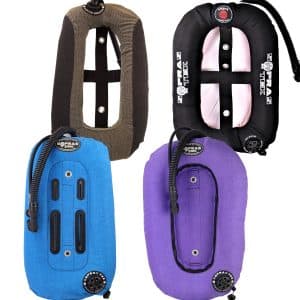
Bladders single tank (11-16l) (11)
-
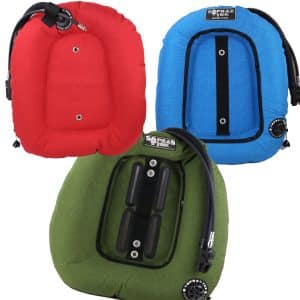
Bladders double tanks (20-30l) (10)
-
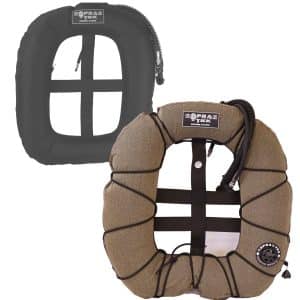
Rebreather and double bladders (4)
Wing Geometry and Rear-Mounted Buoyancy
Unlike a jacket BCD that distributes inflation around the torso, a wing bladder inflates exclusively behind the backplate. This geometry keeps the diver’s centre of buoyancy at the back, counterbalancing the weight of cylinders and creating a stable horizontal trim without active correction. The shape of the wing also matters: a narrow single wing wraps closely around a single cylinder; a wider doubles wing spans the gap between twin cylinders and distributes buoyancy more evenly across the back.
Lift capacity is rated in litres — each litre of bladder volume provides approximately 1 kg of lift when fully inflated. A 14 l wing provides 14 kg of maximum lift; a 30 l wing provides 30 kg. Matching lift capacity to the diver’s total equipment weight is critical: the wing must be able to support the diver at the surface with full cylinders while leaving a reasonable margin, but excess capacity creates a balloon effect when the wing is partially inflated at depth, pushing the diver out of trim.
Bladders Single Tank (11–16 l)
Singles wings for single-cylinder backmount configurations — narrow-profile bladders that avoid ballooning to the sides when inflated around a single tank.
Bladders Double Tanks (20–30 l)
Wider doubles wings with 20–30 l lift capacity, designed for backmount twin-cylinder setups with manifold, regulators, and stage bottle loads.
Rebreather and Double Bladders
Dual-bladder wings and rebreather-specific configurations providing independent or redundant buoyancy chambers for closed-circuit and overhead technical diving.
Single vs. Dual Bladder Wings
A single-bladder wing is simpler, lighter, and easier to service. For open-water technical diving where the diver wears a drysuit — which functions as an independent backup buoyancy source — a single bladder wing is considered adequate by many technical diving agencies. The drysuit can be inflated to compensate for a wing failure, provided the diver has sufficient gas supply and training to manage the ascent.
A dual-bladder wing has two independent chambers: the outer bladder provides buoyancy under normal conditions, and the inner bladder provides redundancy if the outer is damaged or loses integrity. This is standard practice in deep technical diving and most overhead environments (caves, wrecks) where the drysuit may not be a reliable backup — cold water, high ambient pressure, or suit flooding can all compromise drysuit performance as a buoyancy backup. The rebreather and double-bladder category serves divers whose configuration requires this level of redundancy.
What to Look For
- Lift capacity matched to cylinder configuration — calculate your total positive buoyancy at the end of the dive (empty cylinders, all equipment) and ensure the wing can exceed this at maximum depth on a single breath. For single tanks, 11–16 l is the standard range; for doubles, 20–30 l covers most configurations. Add 2–3 kg margin for surface support.
- Wing profile relative to cylinder count — a singles wing is narrow and wraps around a single cylinder without excess bladder volume extending to the sides. Using a doubles wing on a single tank causes the excess bladder volume to balloon outward, disrupting streamlining and making fine buoyancy adjustments harder to control.
- Shell material — Cordura vs. Kevlar — Cordura is the standard for open-water diving; Kevlar-reinforced shells resist abrasion from rock and structure contact in cave and wreck environments. Both materials are used as protective covers over the urethane or TPU bladder; the shell does not affect lift capacity but significantly affects service life in abrasive conditions.
- Dump valve count and position — a minimum of two dump points is standard: a shoulder pull-dump (typically left shoulder) and a lower over-pressure valve. Verify that both can be accessed and operated while wearing gloves in the horizontal position. Wings with an additional right-shoulder dump provide more flexibility for venting gas in different body orientations.
- Backplate mounting compatibility — most wings use a standard tab-and-slot or bolt mounting system that fits common backplate designs. Confirm that the bladder’s mounting geometry is compatible with your existing plate before ordering a replacement bladder.
Maintenance and Care
After every saltwater dive, flush the bladder interior: inflate partially via the oral inflator, pour fresh water through the mouthpiece, fully inflate, then open all dump valves to drain. The salt residue inside the bladder — particularly around the dump valve housings and the inflator connection — accelerates corrosion and degrades the inner lining. Repeat the flush until drained water is clear.
Store the wing with 2–3 breaths of air inside. A completely deflated bladder allows the inner surfaces to press together; over months of storage, the surfaces can bond and tear when the bladder is next inflated. Store hanging or flat, not compressed under other equipment, and away from direct sunlight, heat sources, and petrochemicals including neoprene glues and hydrocarbon solvents.
Inspect the inflator hose connection point and oral inflate mouthpiece for cracking and secure seating annually. Test the over-pressure valve by inflating to maximum capacity and confirming it vents before the bladder shell shows stress — an OPV that is stuck open wastes gas; one that does not open at rated pressure creates over-inflation risk. Any bladder showing delamination, persistent leaking, or structural damage to the shell should be replaced rather than repaired, particularly for overhead diving.
FAQ
What lift capacity do I need for a single tank technical diving setup?
For a single steel 12 l cylinder with a first stage, regulator, and standard accessories, the cylinder is typically 2–4 kg positively buoyant when empty. A 13–16 l wing provides ample lift to support the diver at the surface with a full cylinder and maintains adequate buoyancy margin during the dive. Going below 11 l on a heavy-cylinder single-tank setup is not recommended; going above 16 l introduces excess bladder volume that balloons when partially inflated and disrupts trim at working depth.
Can I use a doubles wing on a single cylinder?
Technically possible but not recommended. A doubles wing is wider and has significantly more volume than a single tank requires. When inflated around a single cylinder, the excess bladder volume wraps around the sides of the diver — the so-called “taco” effect — disrupting the diver’s streamlined profile and making buoyancy control imprecise. If you are building a system you intend to use on both single and double cylinders, a separate wing bladder for each configuration is the correct approach rather than compromising one configuration to serve both.
Is a dual-bladder wing necessary for open-water technical diving?
It depends on your backup buoyancy source and diving environment. Divers using a drysuit have an independent buoyancy backup that can compensate for a wing failure in most open-water scenarios. However, in environments where drysuit flooding is a realistic risk (deep cold-water wreck penetrations, very cold water with thermal stress on seals), a dual-bladder wing removes dependence on a potentially compromised backup. The decision should factor in your diving environment, depth, and the consequence of a buoyancy loss at the planned depth — in overhead environments, a dual-bladder wing is strongly recommended regardless of suit type.
How do I know when a bladder needs to be replaced?
Replace a bladder if it shows persistent slow leaking that cannot be traced to a valve or hose connection, visible delamination between the inner lining and outer shell, cracking around the inflator base or dump valve housings, or any puncture that has been patched more than once. A bladder that holds pressure in controlled testing but leaks gradually under the thermal and pressure cycling of actual dives should be considered end-of-life. For technical and overhead diving, replace on the manufacturer’s recommended service interval rather than waiting for a failure.
Can I replace just the bladder in a complete BCD, or do I need to replace the whole wing assembly?
In most BP/W systems, the bladder (inner urethane or TPU chamber) and the outer shell (Cordura or Kevlar cover) are separate components. Many wings allow the inner bladder to be replaced without replacing the outer shell, or vice versa. Check the manufacturer’s documentation for your specific wing model. If the outer shell is in good condition and only the bladder has failed, a bladder-only replacement is more economical and produces a functionally equivalent result.