BCD hardware covers every metal component used to build, configure, and maintain a backplate and wing or sidemount system — from structural attachment points to adjustment mechanisms. D-rings, buckles, tri-glides, bolt snaps, and cam bands are not accessories in the decorative sense; they are load-bearing components whose material quality, geometry, and corrosion resistance directly determine system reliability underwater. Browse by subcategory to find hardware for backmount, sidemount, or hybrid configurations.
-
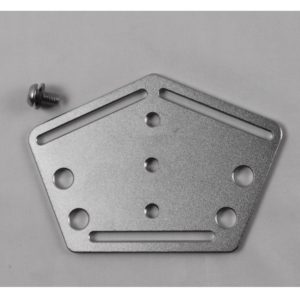
Hardware for Sidemount (13)
-
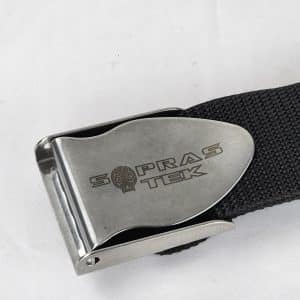
Waist and cylinder buckles (8)
-

D-rings (8)
-
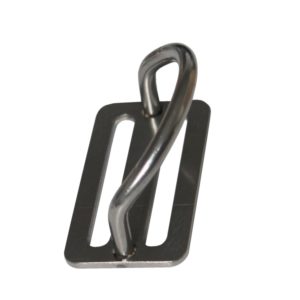
Gliders (5)
-
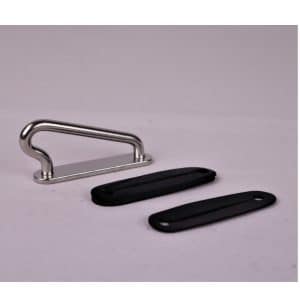
Others (5)
-
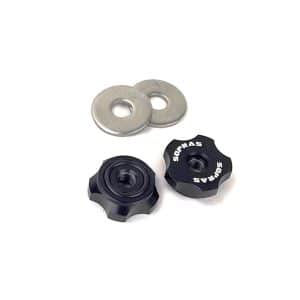
Nuts and screws (10)
The Role of Hardware in a BP/W System
In a minimally configured BP/W system, the hardware count is deliberately kept low — a crotch strap end connector, a few D-rings for equipment attachment, and a cam band for the cylinder. This minimalism is functional: every additional piece of metal hardware is a potential snag point in an overhead environment, an additional corrosion failure point in saltwater, and another item to inspect before every dive. Technical diving hardware standards specify stainless steel for all load-bearing components and discourage brass, zinc alloys, and plastic clips in safety-critical roles.
This category covers the full range of replacement and upgrade hardware: D-rings in multiple sizes and geometries for harness and equipment attachment; waist and cylinder buckles for harness closure; tri-glides (webbing adjustment sliders) for harness length adjustment; hardware for sidemount including cylinder attachment components specific to side-mounted configurations; and nuts and screws for backplate assembly and backplate-to-wing attachment.
Hardware for Sidemount
Cylinder attachment hardware, bungee anchors, hip D-rings, and configuration-specific components for sidemount rigging — 13 products covering the full sidemount hardware range.
Waist and Cylinder Buckles
Stainless steel and aluminium waist buckles for harness closure and cam band buckles for cylinder attachment — load-rated and corrosion-resistant for saltwater technical diving.
D-rings
Stainless steel D-rings in standard and oversized configurations for bolt snap attachment, equipment staging, and harness D-ring replacement across backmount and sidemount setups.
Gliders
Tri-glide webbing sliders for 50 mm technical diving harness webbing — used at shoulder and waist adjustment points to set harness length without re-threading.
Nuts and Screws
Stainless steel hardware for backplate assembly and wing mounting — including nuts for twin tank setups and fasteners for backplate-to-harness attachment points.
Others
Sliding harness adjusters, specialty connectors, and miscellaneous metal components for custom BP/W builds and harness modifications.
D-rings: Size, Material, and Placement
D-rings are the primary equipment attachment points on a technical diving harness. They provide a secure loop for bolt snap attachment of stage bottles, lights, reels, lift bags, and other accessories. In a standard technical diving configuration, D-rings are positioned at both chest shoulders, the left hip, and optionally at the lower harness front — each position serving a specific function. Chest D-rings hold secondary lights and stage regulators; hip D-rings hold the bottom of a stage bottle; additional D-rings are added only when a specific equipment attachment requirement exists.
Stainless steel is the only accepted material for load-bearing D-rings in technical diving — aluminium D-rings are softer and can deform under shock loads from a falling cylinder or a sudden current. The weld at the D-ring base is the critical point: inspect for corrosion pitting and surface cracks at the weld zone, not just the body of the ring. Replace any D-ring with a compromised weld.
What to Look For
- Stainless steel grade — 316L marine-grade stainless steel is the standard for saltwater diving hardware. It contains molybdenum for enhanced chloride corrosion resistance compared to 304-grade stainless. Hardware labelled simply as “stainless” may be 304 grade, which is adequate for freshwater but develops surface corrosion more rapidly in saltwater. For heavy saltwater technical use, 316L is the correct specification.
- D-ring internal diameter relative to bolt snap gate size — the D-ring’s internal opening must be large enough to accept the bolt snap gate cleanly with gloves on. A ring that is borderline — where the snap only just passes through — becomes impossible to operate with neoprene gloves at pressure. Verify that the D-ring dimensions match your bolt snap model.
- Tri-glide sizing for webbing width — tri-glides must match the webbing width exactly. Standard technical diving harness webbing is 50 mm (2 inch). A tri-glide that is too wide allows the webbing to slide laterally and does not maintain adjustment position; one that is too narrow will not thread.
- Buckle load rating — waist and cylinder buckles should be rated for loads appropriate to the equipment weight they will carry. Cam band buckles for cylinder attachment carry significant loads during water entry and equipment handling; verify that the buckle is rated for repeated shock loading, not just static load.
- Thread type and corrosion protection on nuts and screws — backplate assembly screws are subject to galvanic corrosion when dissimilar metals contact (steel screw in an aluminium plate, for example). Use marine-grade anti-seize compound on all fastener threads during assembly to prevent galling and seizure that makes disassembly destructive.
Maintenance and Care
Rinse all hardware with fresh water after every saltwater dive. D-ring welds, buckle hinges, and tri-glide slots accumulate salt in gaps that surface rinsing does not fully reach — soak metal hardware components in fresh water for 15 minutes after intensive saltwater use. Avoid pressure-washing directly into tight mechanical gaps as this can force salt deeper into the joint.
Inspect D-ring welds and bolt snap springs after every dive trip. Corrosion pitting at D-ring welds appears as small brown spots at the weld toe — this is distinct from surface rust staining on the ring body, which is cosmetic. Pitting at a weld indicates active corrosion at the steel grain boundary and warrants D-ring replacement before the next dive. Bolt snap springs that do not close positively or require two-handed operation must be replaced; a spring that partially opens underwater can shed equipment without the diver noticing.
Backplate nuts and screws should be checked for tightness annually and whenever the system is disassembled. Use the correct tool size to avoid cam-out damage to screw heads, which makes future removal difficult. Re-apply anti-seize to threads on reassembly.
FAQ
How many D-rings does a technical diving harness need?
The minimum functional configuration for backmount technical diving is two chest D-rings (one per shoulder) and one or two hip D-rings. This accommodates stage bottle attachment (chest D-ring clips the regulator; hip D-ring clips the cylinder bottom), primary and backup lights, and SMB/reel. Every additional D-ring beyond this functional minimum adds a potential snag point. Sidemount configurations use a different D-ring placement — typically shoulder, chest, and hip positions adapted to the cylinder attachment geometry of the sidemount system.
Is it safe to replace individual D-rings or buckles on a technical diving harness?
Replacing individual D-rings and buckles is standard maintenance practice in technical diving — these components are designed to be replaced. The critical requirement is using hardware of the correct specification (material, size, and load rating) and ensuring that replacement D-rings are correctly positioned and cannot rotate into a closed or obstructed orientation. Do not substitute aluminium hardware for stainless steel in load-bearing positions, and do not use consumer-grade snap hooks or climbing carabiners in place of dedicated bolt snap connectors designed for diving equipment.
What is the difference between a standard D-ring and a locking D-ring?
A standard D-ring is an open loop — a bolt snap can be clipped and unclipped freely. A locking D-ring incorporates a gate or closure that prevents the bolt snap from accidentally unclipping. Locking D-rings are used in specific positions where the risk of accidental equipment loss is high — for example, on a primary light canister. Standard open D-rings are used at positions where the diver needs to detach equipment quickly underwater. The choice of locking vs. open at any position is a configuration decision based on the equipment being carried and the diving environment.
What hardware is specific to sidemount vs. backmount configurations?
Sidemount-specific hardware includes the bungee cord anchor points at the shoulder or chest (for the cylinder neck attachment), the hip D-ring positioned for the cylinder bottom bolt snap, and the sliding harness adjuster that allows the hip D-ring position to be moved along the waist belt to accommodate different cylinder lengths. The Hardware for Sidemount subcategory contains these specialised items. Standard D-rings, buckles, and tri-glides are shared between backmount and sidemount configurations without modification.
Should cam band buckles be replaced periodically?
Cam band buckles should be replaced when the locking tooth shows wear, when the buckle does not hold the band under moderate tension without slipping, or when the pivot point shows corrosion that restricts free movement. There is no fixed replacement interval, but a cam band buckle that slips allows the cylinder to shift position during the dive — this is immediately apparent as a trim problem and should be corrected before the next dive. Inspect the cam mechanism during the pre-dive check by tensioning the band by hand and verifying that the buckle holds without manual assistance.