Showing all 4 results
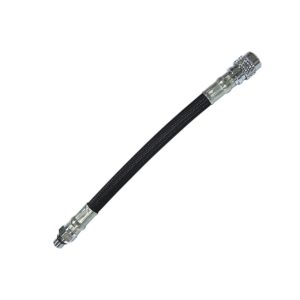
BCD inflator hoses connect the wing bladder to the first stage low-pressure port, supplying gas for buoyancy control. The hose is a mechanical link between the regulator and the BCD inflator mechanism — it must maintain a leak-free connection under the pressure cycling of repeated dives, resist kinking at the inflator connection point, and be long enough to route cleanly from the first stage to the left shoulder inflator position without tension or excess coiling. Four configurations are available to match standard and sidemount BCD setups.
BCD Hose Function and Failure Modes
The BCD inflator hose operates at the LP port pressure of the first stage — typically 8–10 bar above ambient. Unlike high-pressure gauge hoses, the LP inflator hose is not subject to full tank pressure, but it does cycle through pressure changes on every dive. The most common failure point is the hose-to-inflator connection, where the hose fitting seats against the inflator inlet. A micro-crack at this junction produces a slow leak that is audible as a hiss at the inflator but may not be immediately visible as bubbling at depth. The second common failure is internal hose degradation — the inner tube material degrades over years of use and can produce a partial blockage that reduces gas flow to the inflator, making buoyancy fine-tuning sluggish.
Hose length must be matched to the diver’s cylinder and harness configuration. In a standard backmount setup with a manifolded doubles system, the LP hose routes from the right-side first stage, across the back of the cylinders, and up to the left shoulder inflator. In a sidemount setup, the routing is different — the hose comes from the first stage of the right-side cylinder and routes across the chest. Hose length that is correct for a backmount setup may be too short or too long for a sidemount routing.
What to Look For
- Thread compatibility with your first stage LP port — LP hoses use a standardised thread size (typically 3/8″ UNF) that fits most first stage LP ports. However, some manufacturers use alternative thread specifications, and DIN vs. INT configurations may affect how the hose routes from the first stage. Verify thread compatibility before purchasing a replacement hose.
- Hose length relative to your configuration — backmount setups typically use hoses in the 60–75 cm range for standard cylinder heights; sidemount configurations may require different lengths depending on the inflator routing across the chest. Measure your existing hose routing with the correct cylinders attached before selecting a replacement length.
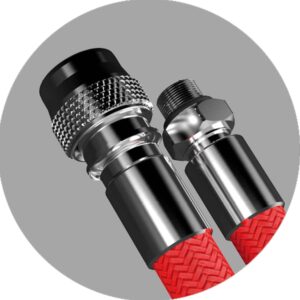
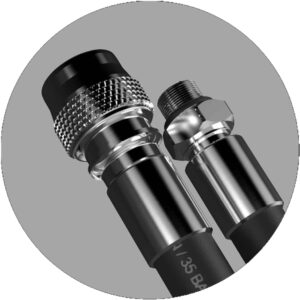
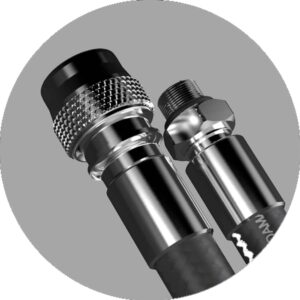
- Fitting quality at both ends — inspect the crimped fitting at the inflator end and the swaged fitting at the first stage end. The crimp should be even around the hose circumference with no gaps or raised edges. A poorly crimped fitting is a leak point that worsens under the pressure cycling of diving.
- Hose material flexibility — the hose must flex at the inflator connection point without kinking under the load of the inflator mechanism weight and the diver’s arm movement. A hose that is too stiff creates a lever on the inflator inlet fitting, increasing the risk of fitting movement and leakage. Check that the hose maintains flexibility at its minimum rated temperature for your diving conditions.
- Brand compatibility with the inflator mechanism — most BCD inflators use a push-and-click or screw-lock connection between the hose and inflator body. Confirm that the hose connection type matches the inflator on your BCD — not all hose-to-inflator connections are interchangeable between manufacturers.
Maintenance and Care
Disconnect the BCD inflator hose from the first stage LP port after every dive trip and rinse both the hose and the LP port with fresh water. Salt that accumulates in the LP port-to-hose connection accelerates corrosion on the brass or stainless steel fitting threads and creates a joint that becomes increasingly difficult to separate at each maintenance interval. Do not leave the hose connected to a pressurised first stage during storage — repeated thermal cycling under pressure accelerates inner tube fatigue.
Inspect the hose visually after every dive trip. Look for swelling of the outer sheath (indicating inner tube delamination or gas infiltration), kinking or permanent set at the connection points (indicating inner tube collapse), and abrasion damage to the outer sheath from contact with cylinder valves or manifold components. A hose showing any of these symptoms should be replaced before the next dive.
Replace BCD inflator hoses on a maximum 5-year interval or at the first sign of degradation, whichever comes first. The inner tube material degrades invisibly — a hose that passes visual inspection may still have compromised inner tube integrity that is only apparent under test. The cost of a replacement hose is negligible relative to the consequence of a hose failure at depth.
FAQ
How do I know if my BCD inflator hose needs replacement?
Replace the hose if you see visible swelling, kinking, outer sheath cracking, or corrosion at either end fitting. Replace it if you detect a slow hiss from the inflator connection point when the system is pressurised. Replace it if the gas flow to the inflator has become sluggish — this indicates inner tube degradation. And replace it on the manufacturer’s recommended interval regardless of visual condition, as inner tube degradation is not always externally visible.
Can I use the same BCD hose for sidemount and backmount diving?
Possibly, but the routing geometry is different between the two configurations and hose length that works for one may be incorrect for the other. In backmount, the hose routes from the right-side first stage around the back of the cylinders to the left shoulder; in sidemount, the hose comes from a side-mounted first stage and routes across the chest. If you use the same first stage for both modes, a single hose may be unusable in one configuration if the length is optimised for the other. Measure your actual routing for each configuration and purchase accordingly — a second hose dedicated to each mode is the cleaner solution.
Does hose length affect buoyancy control response?
Hose length affects gas delivery speed to a minor degree — a longer hose has a slightly larger internal volume that must be filled before gas reaches the inflator inlet. This is a negligible effect under normal LP pressure delivery. What matters more is that the hose is not kinked or partially blocked at the inflator connection, as this creates a genuine throttling effect on gas flow. A hose that is too short creates tension on the inflator inlet fitting, which can introduce a partial restriction at the connection point and slow gas delivery.
What is the correct LP port thread for a BCD inflator hose?
The standard LP hose thread for most BCD inflators is 3/8″ UNF (Unified National Fine), which fits the LP ports of the majority of first stages from all major manufacturers. Some first stages use metric M10 or M12 threads, and a small number of proprietary designs use non-standard specifications. If you are replacing a hose on a non-standard first stage, check the manufacturer’s specification for the LP port thread before ordering. When in doubt, take the old hose and the first stage to a service centre for thread verification.
Is there a performance difference between standard and braided BCD hoses?
Braided hoses have a textile reinforcement layer between the inner tube and outer sheath that prevents the hose from expanding under pressure — relevant for high-pressure applications but less critical at LP BCD pressures (8–10 bar). At LP working pressures, the practical performance difference between braided and non-braided hoses is minimal. Braided hoses are typically stiffer and more kink-resistant, which may be advantageous in routing configurations where the hose must hold a specific shape without a supporting guide. Non-braided hoses are more flexible and lighter, which suits configurations where the hose needs to move freely with the inflator.