Showing all 2 results
The sideback system is a hybrid BCD configuration designed for divers who operate in both sidemount and backmount modes without maintaining two separate complete rigs. A shared harness platform accepts either a backmount wing and single or twin cylinder setup, or a sidemount bladder with side-mounted cylinders — making the sideback an efficient solution for instructors, guides, and technical divers whose diving environments change between open water and overhead.
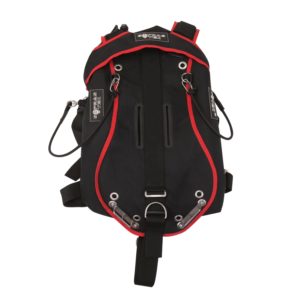
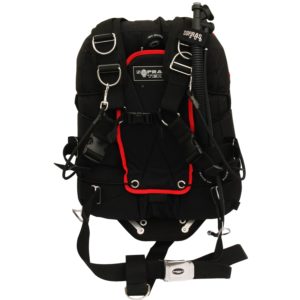
Sideback: Dual-Mode Configuration on a Single Harness
A standard BP/W backmount system and a dedicated sidemount BCD are optimised for their respective configurations — this is their strength, but it requires two complete rigs for a diver who dives both modes. The sideback approach uses a harness and backplate designed with attachment points for both modes: the bladder, cylinder mounting geometry, and inflator routing can be reconfigured between dives rather than between purchasing decisions.
The reconfiguration involves swapping the bladder (backmount wing vs. sidemount bladder), adjusting the hip D-ring and cylinder bungee anchor positions for sidemount, and routing the inflator accordingly. The harness webbing and backplate remain constant. This saves the cost and weight of a second complete BCD system and reduces the total equipment payload for divers who travel to destinations offering different diving environments — ocean open-water technical diving and local cave or wreck diving, for example.
With only two products in this category, the sideback is a specialised segment rather than a broad range. Divers who exclusively dive one mode will find better-optimised options in the dedicated Sidemount or the backmount Complete BCD and Back plates categories. The sideback is specifically for divers who need genuine cross-mode versatility.
What to Look For
- Genuine reconfigurability without specialised tools — the mode switch should be achievable in the field, not requiring workshop access or manufacturer service. Verify that the bladder swap, D-ring repositioning, and inflator rerouting can all be done with standard equipment by a single diver.
- Sidemount-specific features in the shared harness — the harness must have the correct hip D-ring positions, bungee anchor attachment points, and chest routing for proper sidemount cylinder attachment, not just a standard backmount harness with a sidemount bladder bolted on.
- Backmount wing capacity options — when configured for backmount, the system must accept a wing bladder of appropriate capacity for your cylinder setup (singles or doubles). Verify the wing mounting geometry allows the required bladder sizes.
- Total system weight in each configuration — a sideback system typically weighs slightly more than a single-mode-optimised BCD due to the additional mounting points and hardware for both modes. Quantify the weight penalty against the savings from not carrying a second system, particularly for travel diving.
- Availability of replacement and upgrade components — a hybrid system is more complex than a single-mode BCD. Confirm that replacement bladders, harness webbing, and hardware are available as individual parts before committing to the system.
Maintenance and Care
Rinse the complete sideback harness after every saltwater dive, paying particular attention to the dual-mode mounting hardware — the additional attachment points, brackets, and D-ring mounts that differentiate a sideback from a standard harness accumulate salt in their mechanical joints. After the freshwater rinse, inspect all reconfigurable hardware for corrosion at the adjustment points.
After reconfiguring between modes, verify that all connections are secure and all hardware that was moved is correctly locked in its new position before entering the water. A bolt snap that was correctly positioned for sidemount cylinder attachment may be in the wrong location or orientation for backmount equipment. The mode-switch is a system reconfiguration that should be treated as a new equipment setup, requiring the same pre-dive checks as assembling a rig for the first time.
The bladder, whether configured as a backmount wing or sidemount bladder, should be flushed with fresh water internally after each saltwater use following the standard procedure. Store with minimal air inside, in a ventilated location away from UV exposure. Label or tag which configuration the system is currently in if it will be stored before the next dive session — it is easier to verify configuration from a known state than to check every element from scratch.
FAQ
How long does it take to reconfigure a sideback between sidemount and backmount?
An experienced diver familiar with the specific sideback system can typically reconfigure between modes in 15–30 minutes. This includes bladder swap, D-ring repositioning, bungee anchor adjustment, and inflator rerouting. The first few mode switches take longer as the diver learns the correct sequence and hardware positions — rushing a configuration change creates the risk of missing a connection or leaving hardware in an incorrect position. Allow adequate time for the change before the dive, not during equipment assembly at the site.
Is a sideback a compromise compared to a dedicated sidemount or backmount system?
In each individual configuration, a sideback is typically slightly less optimised than a purpose-built single-mode system — there is additional hardware present that serves the other mode, and the harness geometry may represent a compromise between the ideal sidemount and backmount positions. For divers who use both modes regularly, this trade-off is worthwhile. For divers who use one mode 95% of the time and the other only occasionally, maintaining two separate single-mode systems or renting a second rig may be more practical than accepting the ongoing compromise of a hybrid system.
Can I use any wing with a sideback harness in backmount mode?
The sideback harness and backplate will accept wings that are compatible with its mounting geometry — this typically means standard tab-and-slot BP/W wing mounting. However, the specific wing capacity must still match the cylinder configuration: a singles wing for single-cylinder backmount, a doubles wing for twin cylinders. The sideback system does not change this fundamental requirement. Confirm that the wings you intend to use are mechanically compatible with the sideback plate design before assuming cross-compatibility.
Is a sideback suitable for cave diving in both modes?
This depends on the specific product and the cave diving configuration requirements. For cave diving, both sidemount and backmount configurations must meet the snag-reduction, equipment accessibility, and buoyancy redundancy standards appropriate for the environment. A sideback configured for cave sidemount must have the same functional characteristics as a dedicated sidemount cave system — correct inflator routing, accessible dump valves in the horizontal position, and secure cylinder attachment without excess hardware projecting into the restriction. Contact a cave diving instructor or the equipment manufacturer for a configuration assessment before using any hybrid system in an overhead environment.
Are sideback systems suitable for students learning sidemount for the first time?
Sideback systems are not typically the recommended starting point for sidemount training. Learning sidemount diving is easier with a system that is optimised for the sidemount configuration — where the inflator routing, dump valve positions, and cylinder attachment geometry are designed from the ground up for that mode. A sideback introduces additional complexity at a stage when the diver is still building fundamental sidemount skills. Once sidemount fundamentals are established, transitioning to a sideback system for versatility is straightforward.