Showing all 4 results
Hardware for assembling and completing backmount double cylinder sets: stainless steel twin tank bands in standard and wide formats (50–51 €), rubber double tank boots, EPDM tank protectors for band contact points, and complete configured twin sets (635–846 €) with cylinders, manifold, and bands ready to dive. Four products covering new double set assembly and component replacement.

Twin Cylinder Configuration Hardware
A backmount double set requires two cylinders to be rigidly coupled and connected by a manifold. The physical coupling is achieved with stainless steel twin tank bands — two bands per set, positioned at the upper and lower cylinder body, tightened with bolts through the band ends to clamp both cylinders together. The bands must be tightened to the point where no movement is possible between the cylinders — any shift in the set changes the centre of gravity and can affect trim, valve access geometry, and manifold stress.
Stainless Steel Twin Tank Bands
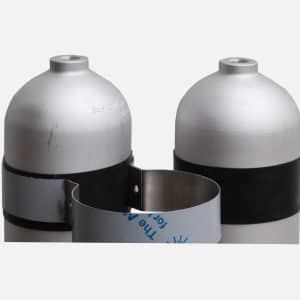
The Stainless steel twin tank band (50–51 €, SKU 760100/760121) is available in two variants — a standard band and a wider or alternative-profile version. Both are 316 stainless steel for corrosion resistance in saltwater environments. The band price is per band; a double set requires two bands, plus a bolt kit. Check whether the bolt hardware is included or needs to be ordered separately. Band sizing must match the outer diameter of your specific cylinders — standard 12 L steel cylinders typically use 171 mm OD bands.
Double Tank Boot
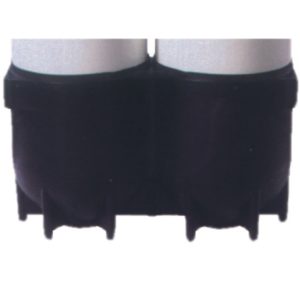
The Double tank boot (32 €, SKU 76020/0-1) is a rubber base protector that fits over the bottom of both cylinders as a unit, providing a stable standing base for the assembled double set and protecting the cylinder bases from impact. Cylinder boots prevent the metal bases from sitting directly on concrete, rock, or boat surfaces — reducing edge damage and providing grip on smooth surfaces. Two size variants cover different cylinder base diameters.
EPDM Tank Protector
The EPDM tank protector (10 €, SKU 760150, 180 mm diameter) is a rubber sleeve or pad that fits around the cylinder body at band contact points to prevent galvanic corrosion between the stainless steel band and the cylinder surface, and to cushion the band grip to prevent surface damage. EPDM (ethylene propylene diene monomer) rubber is resistant to UV and saltwater — it does not degrade in the diving environment as fast as standard natural rubber. Used at the band contact position to protect cylinder coatings and reduce metal-to-metal contact.
Complete Twin Tanks Sets
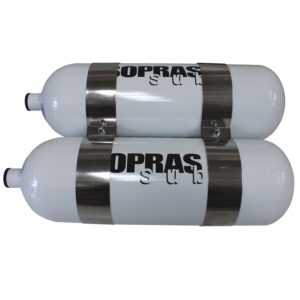
The Twin tanks sets (635–846 €, SKU 720040/1-10) are factory-configured complete double sets including cylinders, manifold, and bands. The range of SKU variants across the 720040 range covers different cylinder volumes, pressure ratings (232 bar vs. 300 bar), and manifold configurations. This is the starting point for a diver building a complete backmount double configuration — a single order provides a matched, ready-to-assemble set rather than sourcing cylinders, manifold, and bands separately.
What to Look For
- Band tightening and security: Twin tank bands must be tightened to zero cylinder movement. A torque wrench is not standard kit for most divers, but band bolts should be tightened progressively and evenly and checked before every dive trip. Loose bands shift during transport and can arrive at the dive site out of alignment.
- Complete set vs. components: If building a double set from individual components, you need: two cylinders, one manifold, two bands with bolts, two tank boots, and two EPDM protectors at minimum. The Twin tanks sets SKU bundles these into a single order — typically more cost-effective than sourcing components individually if you are starting from scratch.
- Boot size: The double tank boot must fit the specific outer diameter of your cylinders at the base. Two sizes are available (76020/0-1) — confirm which covers your cylinder base OD before ordering.
FAQ
How tight should twin tank bands be?
Tight enough that you cannot rotate either cylinder relative to the other when gripping firmly by hand. Any detectable movement between the cylinders indicates the bands need to be tightened further. The consequence of loose bands is that the manifold geometry shifts relative to the valve positions, placing stress on the manifold-to-valve connection o-ring interfaces and potentially causing leaks. Check tightness before every dive.
Do I need EPDM protectors on every set?
They are not mandatory but are recommended for any set used in saltwater. Without protectors, the stainless steel band sits directly on the cylinder surface — typically painted steel. Salt water trapped in the gap creates the conditions for crevice corrosion over time. EPDM protectors are a 10 € component that protects a significantly more expensive cylinder surface. On aluminium stage cylinders with cam bands rather than twin bands, a rubber protector under the cam band serves the same function.