Showing all 4 results
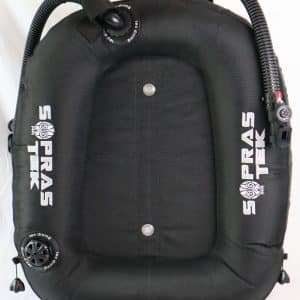
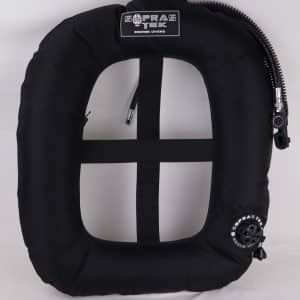
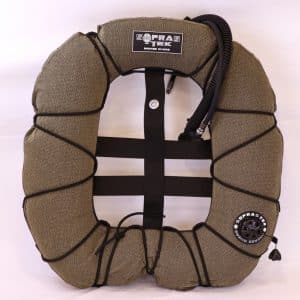
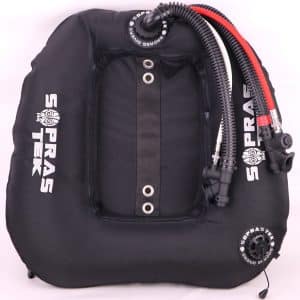
Specialist bladder configurations for rebreather backmount use and dual-bladder redundant lift systems. Rebreather bladders use a modified geometry that accommodates the width and back profile of closed-circuit rebreather (CCR) units rather than open-circuit cylinder setups. Dual-bladder wings provide two independent lift chambers on a single harness — a primary chamber and a redundant backup — for technical and cave diving where buoyancy control redundancy is required.
Rebreather Bladder Geometry
CCR units have a different back profile than open-circuit doubles — wider, shallower front-to-back, and with a fixed harness attachment system that differs from standard BP/W geometry. The Rebreather bladder (24009E) is configured for standard CCR back dimensions and mounts to rebreather-compatible backplates. The Rebreather bladder Extralarge is a higher-volume variant for larger CCR units or configurations requiring additional surface lift — the extra-large volume compensates for the shallower bladder profile where volume is constrained by the CCR’s width rather than cylinder diameter. Both bladders use the standard inflator and OPR valve system.
Dual Bladder Wings
The Donut XL Double Bladder (24009T) and X tech double bladder (24005A) each contain two independent lift chambers in a single wing housing. In normal operation, only the primary chamber is used. If the primary chamber fails — valve fault, puncture, hose separation — the secondary chamber can be inflated independently to maintain buoyancy control during ascent. This configuration is required for certain cave and deep technical diving certifications and is standard practice in environments where a buoyancy failure without a backup is an unacceptable risk. The double bladder does not provide significantly more total lift than a single-chamber wing of equivalent external dimensions — the lift capacity is divided between the two chambers, not doubled.
What to Look For
- CCR unit compatibility — verify that the rebreather bladder dimensions match your specific CCR unit. CCR back dimensions vary significantly between manufacturers and models. The backplate and harness mounting points must also be compatible with the CCR’s own attachment system.
- Dual bladder training requirement — operating a dual-bladder wing correctly requires training. The secondary chamber inflator and dump valve routing must be understood before diving. Do not purchase a dual-bladder system without appropriate technical diving training.
- Volume selection for CCR — rebreather bladder volume should account for the weight of the CCR unit itself (typically 10–18 kg depending on scrubber and bailout configuration). The extra-large variant is appropriate for heavier CCR setups where the standard bladder does not provide sufficient surface lift for safe exits.
FAQ
Do I need a dual-bladder wing for technical open-circuit diving?
The requirement depends on the dive plan and the standards of the training agency or dive team. Many technical divers use a single-bladder wing backed by a drysuit for buoyancy redundancy — in a drysuit, the suit itself provides an alternative lift source if the wing fails. In a wetsuit or in environments where drysuit inflation cannot be relied upon as a backup, a dual-bladder wing is the appropriate redundancy system. Cave diving agencies typically require or strongly recommend dual-bladder configurations for overhead environment diving beyond certain penetration depths.
Can the Donut XL Double Bladder be used as a standard wing if only one chamber is connected?
The double bladder is designed for dual-chamber operation — using only one chamber without the second connected is possible during configuration or testing but is not the intended operational mode. The two chambers affect each other’s geometry when inflated, and a partially configured dual-bladder wing will not perform identically to a standard single-chamber wing of the same volume.