Showing all 8 results
Stainless steel and aluminium D-rings for technical diving BCD harnesses. D-rings are the primary attachment points for stage cylinders, SMBs, lights, reels, and other equipment carried clipped to the harness. Material, geometry (straight vs. curved), size (25mm, 40mm, 50mm), and construction method (welded vs. open) determine load rating, clip orientation, and how the D-ring sits on the harness webbing.

D-ring Geometry and Selection
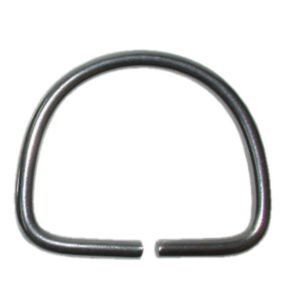
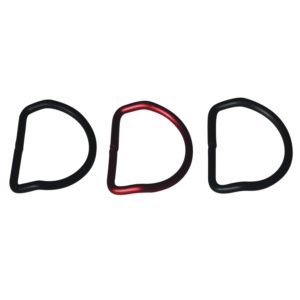
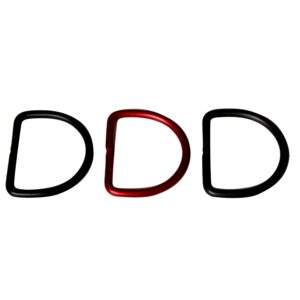
The 50mm D-rings are the standard technical diving attachment size — large enough to accept a bolt snap or cave clip without difficulty in gloves, and rated for the loads generated by stage cylinders and reels. The D-ring SS straight 50mm welded (804010) is a fully welded ring with no open point — the weld closes the ring, preventing the clip gate from shifting to an open position under the ring. The D-ring SS straight 50mm open (804009) has an open gap at the base that allows the ring to slide onto webbing without threading — used where the D-ring must be added to an existing harness assembly without disassembling the webbing. The D-ring SS curved 50mm welded (804011) uses a curved arm geometry that keeps bolt snaps aligned along the long axis of the D — this reduces gate-loading (a scenario where force is applied across the gate rather than along the spine) and is preferred by cave divers for stage and light attachments. Aluminium D-rings — D-ring alu curved 50mm anodized (804021/31) and D-ring aluminium straight 50mm (804020/30) — are available in anodised finish and provide a lighter option where the load requirements do not demand stainless steel. Smaller D-rings — D-ring SS 25mm (804013), D-ring SS 40mm (804012), D-ring alu 25mm (804023) — are used for lighter items such as SMB attachment, reel clips, and instrument gauge retention where a full 50mm D-ring would be oversized.
What to Look For
- Welded vs. open base — welded rings are stronger and prevent clip migration; open-base rings allow retrofitting to an existing harness. If building a new harness, use welded. If adding to an assembled harness, open-base avoids complete disassembly.
- Curved vs. straight arm — curved geometry reduces gate-loading risk. For stage and sidemount cylinder attachment, curved is preferred. For lighter items, straight is sufficient.
- Size matching to clip type — verify that the D-ring opening is large enough to accept your bolt snap or cave clip with one hand in a glove. A 50mm D-ring is the minimum for a standard bolt snap; 25mm and 40mm D-rings are for small clips only.