Showing all 10 results
Sidemount diving positions cylinders alongside the diver’s body rather than on the back — a configuration that originated in cave exploration and is now widely used in technical open-water diving for its inherent gas redundancy, direct valve access, and low-profile geometry. This category covers complete sidemount BCD systems (Sidemount System 2025, Sidemount BCD 17 litres, Travel Sidemount BCD, SIDEMOUNT BC 1225, Sidemount system NEW) as well as purpose-built cargo pouches and weight pockets for sidemount-specific rigging.


Sidemount BCD Systems: Configuration and Bladder Geometry
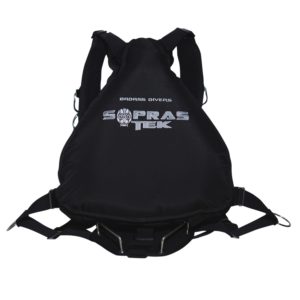
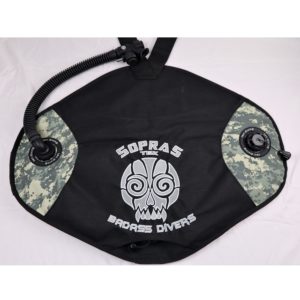
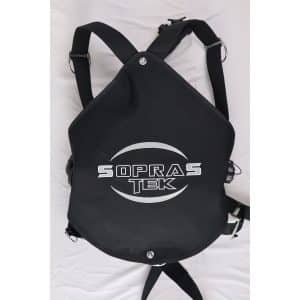
A sidemount BCD differs from a backmount wing in bladder shape, inflator routing, and the way cylinders attach to the harness. Rather than a single rear-mounted wing that inflates behind twin cylinders, a sidemount BCD typically uses a kidney-shaped, triangular, or donut bladder that concentrates buoyancy at the lower back and hips — the natural centre of gravity for a horizontal diver with cylinders mounted at the sides. The Sidemount BCD 17 litres uses a 17 l bladder in this geometry; the SIDEMOUNT BC 1225 covers a 12–25 l lift range in its variants.
The inflator is routed under the arm and across the chest rather than over the shoulder, keeping the hose accessible in the horizontal position without the diver needing to reach overhead. Dump valves are positioned for operation in the prone position. Cylinder attachment uses a bungee cord at the neck valve (pulling the cylinder tight against the body) and a bolt snap or clip at the hip, with the cylinder running parallel to the diver’s torso.
The Sidemount System 2025 represents the current production model; the Sidemount system NEW is the previous generation for divers already familiar with that design. The Travel Sidemount BCD is dimensioned for compact packing and airline travel, with a collapsible profile when deflated. The LZ DONUT SM 14L WITH HARD PLATE (listed under Complete BCD) uses a donut-geometry bladder that wraps around the lower torso for sidemount configurations requiring a specific lift distribution.
Sidemount Accessories: Cargo Pouches and Weight Pockets
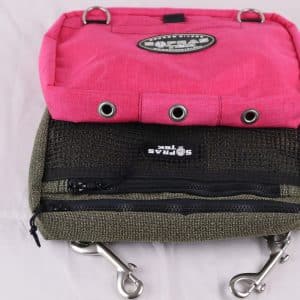
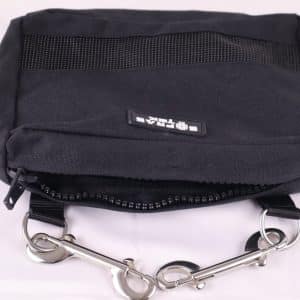
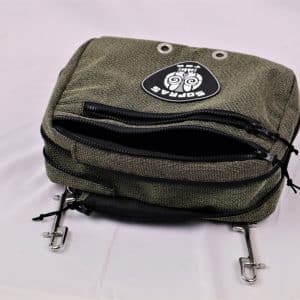
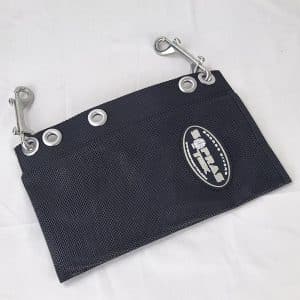
Sidemount diving requires a streamlined equipment profile — items that would be mounted on a backmount BCD must be repositioned or eliminated. The cargo pouch range (Cargo pouch for Sidemounters, Cargo pouch MINI, Expandable Cargo pouch, Net pouch w side opening) provides attachment points for SMBs, reels, slates, and other equipment that cannot be clipped to a D-ring without creating snag hazards in a sidemount geometry. The expandable pouch offers a variable internal volume of 20×30×8–12 cm for items that cannot be compressed. The net pouch with side opening allows quick access to frequently used items without unbuckling and removing the entire pouch.
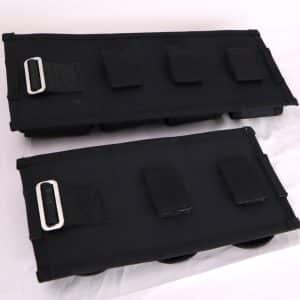
The Sidemount weight pockets mount to the lower harness and allow ballast to be positioned at the hips — the correct weighting position in sidemount diving, where lead carried at the waist or integrated into the BCD creates trim problems.
What to Look For
- Bladder lift capacity relative to cylinder count — a sidemount BCD with 12–17 l of lift is sized for two cylinders of standard recreational to light technical volume. Divers running large-volume steel cylinders in sidemount may require higher lift; verify that the BCD’s rated lift exceeds the positive buoyancy of both cylinders when empty.
- Cylinder attachment geometry — the bungee cord routing at the neck valve and the hip attachment point (bolt snap clip angle and position) determine how cleanly the cylinder sits against the body. Systems with adjustable bungee positioning allow the cylinder to be trimmed to different lengths and diameters without modifying the BCD.
- Inflator hose routing — in sidemount, the inflator runs across the chest and must be reachable with either hand. Confirm that the hose length and routing on the BCD matches your cylinder and regulator layout, and that the inflator button mechanism functions correctly with one hand while the other manages a cylinder valve.
- Dump valve position and accessibility — at least one dump should be at the left shoulder (pull-dump) and one at the lower back/hip (OPV). In the prone sidemount position, you should be able to vent gas from the bladder without rolling or lifting your head significantly.
- Travel packability — if the sidemount BCD will be used as a travel system, check the packed dimensions and weight. The Travel Sidemount BCD is specifically designed for this; standard sidemount systems may pack smaller than backmount wings but still require careful arrangement in a dive bag.
Maintenance and Care
Rinse the sidemount BCD thoroughly after saltwater use — the cylinder attachment hardware (stainless bungee anchors, bolt snap connection points, hip D-rings) accumulates salt at mechanical joints. Detach cargo pouches before rinsing and flush them separately; salt in the pouch zipper mechanism accelerates zipper failure. Flush the bladder interior the same way as any wing: fresh water through the oral inflator, full inflation, drain through all dump valves.
Inspect bungee cords at regular intervals — UV and ozone exposure degrade natural rubber bungees significantly faster than nylon webbing. A bungee that has lost elasticity will not hold the cylinder neck snug against the body, allowing the cylinder to oscillate during the dive and affecting trim. Replace bungees when they show permanent set (stretched slack state) or visible surface cracking.
Weight pocket mounting hardware should be checked for corrosion at the webbing attachment points. Cargo pouches with metal zipper sliders should be rinsed with the zipper open, then lubricated with a silicone-based lubricant after drying to maintain smooth operation and prevent corrosion welding of the slider to the zipper chain.
FAQ
Is sidemount diving harder to learn than backmount technical diving?
Sidemount introduces different buoyancy control and equipment management challenges compared to backmount — buoyancy is felt differently with cylinders at the sides rather than behind, and valve drills require a different reach pattern. The learning curve for an experienced backmount technical diver is moderate; the transition typically takes several dedicated training dives to internalise the muscle memory for cylinder valve management and inflator reach. Entry-level sidemount training is available from all major technical diving agencies, and many divers find that the direct valve access and gas redundancy justify the investment in learning the configuration.
Can I use a sidemount BCD for backmount diving?
Sidemount BCDs are not designed for backmount use — the bladder geometry, inflator routing, and lack of cam band attachment points on the back make them unsuitable for mounting cylinders behind the diver. If you need a system that can be configured for both modes, look at the Sideback category, which covers hybrid systems specifically designed to switch between sidemount and backmount configurations using a shared harness platform.
How are cylinders attached to a sidemount BCD?
Standard sidemount rigging attaches each cylinder independently: a bungee cord connects from the BCD harness (typically at shoulder or chest level) to the cylinder neck valve, pulling the top of the cylinder tight against the diver’s side. The bottom of the cylinder clips via a bolt snap to a D-ring at the hip, angled so the cylinder runs parallel to the diver’s body from hip to armpit. This configuration gives direct visual and manual access to both valves without a manifold, and allows each cylinder to be removed or re-clipped underwater independently.
What is the Travel Sidemount BCD designed for?
The Travel Sidemount BCD (240700) is built for divers who use sidemount as their primary configuration and need a system that packs compactly enough for airline travel as checked or carry-on luggage. The bladder and harness are designed to compress and fold without damage to the bladder material, and the hardware profile minimises bulk in a packed bag. The functional configuration is equivalent to standard sidemount systems — it is a travel-specific packaging of the sidemount concept, not a reduced-capability version.
Do I need special cylinders for sidemount diving?
Standard aluminium or steel cylinders with DIN or INT valves are used in sidemount diving, but cylinder length and diameter affect how they sit against the body. Cylinders that are too long extend past the fins and create snag hazards; very wide cylinders push away from the body and create drag. For cave and tight restriction diving, 7–10 l cylinders are common. For open-water technical sidemount diving with higher gas volumes, 11–12 l cylinders are standard. The BCD’s bungee routing can often accommodate a range of cylinder lengths, but check the manufacturer’s recommended cylinder specifications for the specific system you are purchasing.