Showing all 5 results
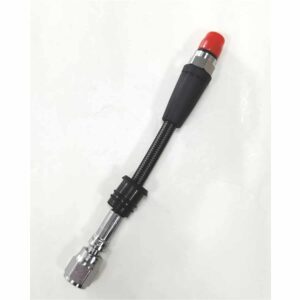
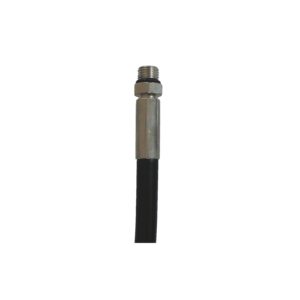
Five high-pressure hose products for connecting SPGs to first stage HP ports: rubber black HP hoses in four lengths, braided HP hoses in 15 and 30 cm, HP hoses in ACCPur polymer, and an HP swivel to eliminate torsional stress on gauge port connections. High-pressure hoses carry full cylinder pressure — 200–300 bar — and must not be confused with LP hoses.

High-Pressure Hose Specifications
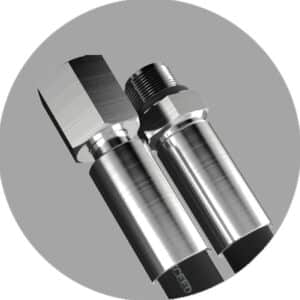
High-pressure hoses carry gas at full cylinder pressure — typically 200–300 bar in technical diving — from the first stage HP port to a submersible pressure gauge. The pressure differential between HP and the surrounding water is enormous at depth; HP hose failure is a serious incident. HP hoses are constructed with heavy reinforcement layers — typically steel braid wound around an inner tube — and rated to well above working pressure. They use different fittings and thread specifications than LP hoses, though some overlap exists; always verify hose type before connecting to a port.
The HP hose rubber black (SKU 900400/2/3/4) provides four length variants of standard rubber-jacketed HP hose. The Braided high pressure hoses (SKU 900580/1) in 15 and 30 cm are the compact options for wrist-worn SPG configurations where a short stiff hose is preferred over a longer flexible one. The HP hoses ACCPur (SKU 900405/8) use an ACCPur polymer jacket — a synthetic material providing flexibility, UV resistance, and chemical resistance in a lighter package than rubber.
The HP Swivel
The HP swivel (SKU 909000, 7 €) is a rotating joint installed between the HP hose and the first stage gauge port. Its function is to allow the hose and gauge to rotate freely relative to the first stage, eliminating torsional load on the HP port connection. Without a swivel, an SPG worn on the wrist — changing position with arm movement — transmits rotation to the HP port fitting, gradually loosening the connection or fatiguing the hose end. At 7 €, it is one of the most cost-effective equipment longevity upgrades in this category.
What to Look For
- Never use LP hoses on HP ports: LP hoses are rated for 10–15 bar above ambient. HP ports deliver 200–300 bar. Connecting an LP hose to an HP port produces immediate catastrophic failure. HP and LP hose fittings can look similar; verify the hose pressure rating and the port designation (HP/LP marked on most first stages) before every connection.
- Length for SPG routing: Short HP hoses (15–30 cm braided) are used for compact console configurations or SPGs mounted close to the first stage. Longer rubber hoses allow more freedom of movement for wrist-worn SPGs. The correct length depends on whether the SPG is console-mounted, hose-end clipped, or wrist-worn on a bungee.
- Braided vs. rubber vs. ACCPur: Braided stainless outer provides the best abrasion resistance for cave and wreck environments. Rubber provides flexibility and cushioning. ACCPur polymer is lighter than rubber and resistant to UV and chemicals — a good choice for divers who store or travel with equipment exposed to sunlight or cleaning agents.
- HP swivel for wrist-worn SPGs: Any configuration where the SPG rotates relative to the first stage — wrist-worn, bungee-mounted — should use an HP swivel to protect the HP port connection. The 7 € cost is negligible relative to the thread damage it prevents.
- Oxygen-rated HP hoses for deco bottles: For SPGs on oxygen or high-nitrox cylinders, ensure the HP hose is oxygen-compatible. Standard rubber HP hoses are typically compatible with up to 40% O₂; above that, oxygen-specific materials are required. Check product specifications for the oxygen fraction limit of each hose construction.
Maintenance and Care
Inspect HP hoses before every dive at the end fittings for cracking, corrosion, or deformation. The end fitting crimp is the highest-stress point; any separation between the fitting and hose body requires immediate replacement — do not dive with a suspect HP hose. HP hoses should be replaced every 3–5 years regardless of visual condition, consistent with LP hose replacement guidelines. The HP swivel should be rinsed, lubricated with a small amount of Christo Lube at annual service, and inspected for smooth rotation — a seized swivel is non-functional and may need replacement.
FAQ
How do I identify HP vs. LP ports on a first stage?
HP ports are typically labelled “HP” or have a smaller thread diameter than LP ports. LP ports are usually labelled “LP” and are more numerous — a typical technical first stage has 4 LP ports and 2 HP ports. The HP port accepts the gauge hose; all other hoses (second stage, octopus, BCD inflator, drysuit) connect to LP ports. If in doubt, check the first stage manual — the port configuration is clearly diagrammed for each model.
What length HP hose for a wrist-worn SPG?
For a backmount diver with an SPG worn on the right wrist, the HP hose typically routes from the right first stage, up the right side, and to the wrist — a length of 60–90 cm depending on body size and routing path. For compact chest-console configurations, 30–45 cm is common. The short braided HP hoses (15–30 cm) are designed for very compact SPG positions close to the first stage — typically used in cave diving where minimal hose routing is preferred to reduce snag risk.
Is the HP swivel necessary or optional?
Optional in the sense that the regulator functions without it. Practically, for any SPG that moves relative to the first stage — wrist-worn, bungee-clipped — the HP swivel prevents torsional fatigue of the HP port thread and hose end. Over dozens of dives, the cumulative rotation of an SPG without a swivel can loosen the HP port fitting and cause slow gas loss. At 7 €, the swivel is a practical recommendation for any wrist-mounted SPG configuration.
Can HP hoses be repaired if a fitting is damaged?
No. HP hoses with damaged, corroded, or deformed end fittings must be replaced. There is no field repair for HP hose end fittings — re-crimping requires factory equipment and pressure testing. A hose with compromised end fittings must be taken out of service immediately. Carry a spare HP hose when diving in remote locations where replacement is not immediately available.
What is ACCPur and why would I choose it over rubber?
ACCPur is a synthetic polymer used as an outer hose jacket. It is lighter than rubber, more flexible at low temperatures, UV-resistant, and resistant to the cleaning agents and solvents that degrade rubber over time. For divers who store equipment in outdoor or UV-exposed environments, clean equipment with alcohol or detergent-based solutions, or need lighter hose weight for travel, ACCPur provides meaningful advantages. For straightforward pool or temperate sea diving, standard rubber HP hoses are functionally equivalent at a lower cost.