Showing all 7 results
Seven pressure monitoring instruments for technical diving: TEK-series SPGs in 300 bar, 450 bar/oxygen, and 5000 psi scales, a TEK plated 300 bar variant with brass snap clip, a modular head-of-gauge component for custom console builds, and a bungee-mounted compass. All instruments connect to HP ports via standard high-pressure hose connections.
For more gauges please check SoprasSub gauges.
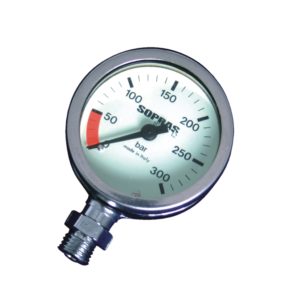
Submersible Pressure Gauges for Technical Diving
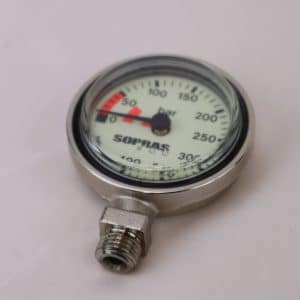
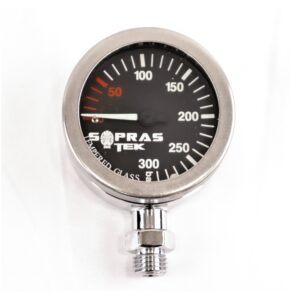
A submersible pressure gauge (SPG) provides direct cylinder pressure readout via an HP hose connected to the first stage. In technical diving, SPGs are typically worn on a wrist or bungee-mounted rather than in a console, allowing the diver to check gas status without changing body position or looking away from the dive environment. The TEK series from Sopras Tek uses a back-reading dial format with a high-visibility scale designed for rapid pressure checks at depth.
For technical diving with mixed gas, the TEK pressure gauge 450bar/oxygen (SKU 501312) is the critical variant — it is rated and labelled for oxygen-rich mixes and constructed with oxygen-compatible materials. Using a non-oxygen-rated SPG on an oxygen or high-O₂ nitrox cylinder is a safety risk; the oxygen-rated variant is the correct specification for deco bottles and O₂ stage cylinders.
Scale and Unit Selection
Three pressure scales are available: 300 bar (standard for European cylinders), 450 bar/oxygen (for oxygen-service use up to 450 bar), and 5000 psi (for Imperial-market cylinders). When building a gas management system with multiple cylinders carrying different gasses, using distinctly labelled SPGs — standard for air/nitrox and oxygen-rated for O₂ — prevents mix-ups during pre-dive gas checks. The 5000 psi variant is appropriate for divers who also dive with North American cylinders rated in Imperial units.
What to Look For
- Oxygen rating for high-fraction gas: For any cylinder carrying more than 40% O₂, an oxygen-rated SPG is mandatory. The TEK 450bar/oxygen is the correct instrument. Do not use standard 300 bar SPGs on oxygen or high-nitrox cylinders.
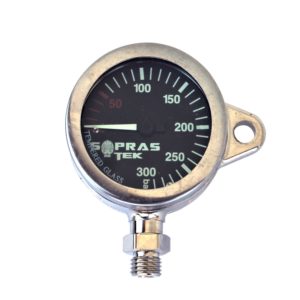
- Bungee vs. hose-end mounting: The standard TEK SPG connects to an HP hose and can be worn on the wrist with a bungee loop or clipped to the rig. The TEK plated 300 bar with brass snap (SKU 50131S) includes an integrated brass snap for direct clipping without a separate retaining system.
- Modular head of gauge: The Head of gauge (SKU 501202) is the pressure-reading head component without a specific hose — used for custom console builds or replacing a damaged gauge head on an existing HP hose and body assembly.
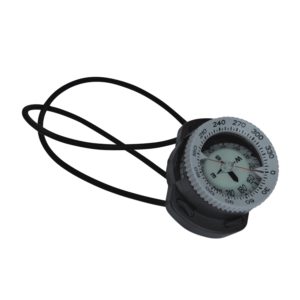
- Compass for navigation: The Compass with bungee (SKU 522400) provides a wrist-worn navigation reference. Bungee mounting is the standard technical diving method — the compass slides over the wrist without a watch strap and is held in place by bungee, allowing quick removal and consistent positioning.
- HP hose compatibility: All TEK SPGs connect via standard HP hose fittings. HP hoses in multiple lengths and constructions are available in the HP Hoses category. Match hose length to your routing — shorter hoses (15–30 cm) for wrist-worn SPGs, longer for console positions.
Maintenance and Care
Rinse SPGs in fresh water after every dive, paying attention to the HP hose connection and the back of the gauge body where salt deposits accumulate. Inspect the HP hose for kinking, cracking, or swelling at the ends — high-pressure hose failure at depth is a critical incident. Do not over-bend HP hoses at connection points; use the HP swivel (available in HP Hoses) to eliminate torsional stress on gauge port connections. Oxygen-rated SPGs must be kept free from hydrocarbon contamination — store them separately from non-oxygen equipment and do not use non-oxygen-compatible lubricants near the HP connection.
FAQ
What is the difference between the 300 bar and 450 bar/oxygen gauges?
The 300 bar gauge is calibrated for standard diving cylinders pressurised to 200–300 bar with air or nitrox. The 450 bar/oxygen gauge is calibrated to a higher maximum pressure and constructed with oxygen-compatible materials and lubricants for use with high-fraction oxygen mixes or pure O₂. Using a standard 300 bar gauge on an oxygen cylinder is a safety risk due to material incompatibility with high-fraction oxygen environments. Always use the oxygen-rated variant on cylinders carrying more than 40% O₂.
How do I mount a TEK SPG for wrist reading?
The standard method is a bungee loop threaded through the gauge body or a bungee ring attached to the gauge, worn over the drysuit or wetsuit wrist. This holds the gauge against the inner forearm for reading during the dive without a watch-style strap. The HP hose routes up the arm and back to the first stage on the cylinder. Hose length selection — typically 60–80 cm for a backmount first stage reading a wrist-worn gauge — determines how the hose sits during the dive.
Is the TEK 5000 psi gauge interchangeable with the 300 bar gauge mechanically?
Yes. The 5000 psi and 300 bar gauges use the same HP hose connection and are mechanically identical; only the dial scale differs. 5000 psi ≈ 344 bar, so the scale range is comparable. If you dive internationally with both metric-rated and Imperial-rated cylinders, either gauge can be used on any cylinder — the scale will simply read in different units. Most technical divers prefer to have consistently-scaled instrumentation across their gas management system to avoid mental conversion during gas planning.
What is the Head of gauge component?
The Head of gauge (SKU 501202) is the pressure-measuring element and dial assembly without an attached hose. It is used in modular gauge console configurations where the hose and gauge head are separate components, or as a replacement head for an existing gauge assembly where the dial or body has been damaged. It connects to a standard HP hose fitting. If you are building a custom console or replacing a failed gauge head on an existing hose, this is the appropriate component.
Can I use the compass for navigation in zero-visibility conditions?
The Compass with bungee provides a magnetic bearing reference. In zero or near-zero visibility, a wrist compass supplements navigation but cannot replace methodical line use, dive planning, or turn-pressure discipline. The bungee mounting positions the compass on the inner wrist for easy reading during navigation swims. Compass accuracy is affected by proximity to ferromagnetic materials — steel cylinders, tanks, and structures can deflect the needle; read the compass while holding it away from the body and cylinder hardware for accurate bearings.